
Tokyo sorts household rubbish into several types, and each type has its own collection day. The exact rules depend on your ward and your building, so always follow the guide for your own address.
On your first day, find out where the bins are, which bags to use and when you can put rubbish out. Take a photo of the instructions so they are always on your phone.
The main categories
| Japanese label | Meaning | Common examples |
|---|---|---|
| 可燃ごみ or 燃やすごみ | Burnable rubbish | Food scraps, tissues and dirty paper |
| 不燃ごみ | Non-burnable rubbish | Metal, glass and ceramics; local names vary |
| 資源 | Recyclables | Paper, bottles, cans and other materials your ward collects |
| ペットボトル | PET bottles | Plastic drink bottles with the PET mark |
| 資源プラスチック | Recyclable plastic | Plastic items accepted under your ward's rules |
These are only the most common categories. The rules for plastic differ most from ward to ward. In Shinjuku, for example, clean plastic products are collected as recyclable plastic (page in Japanese), so not all plastic goes into burnable rubbish.
How to prepare everyday items
- Drain food scraps before you put them in the rubbish bag.
- Empty and rinse drink bottles and cans, then separate them as your building guide says.
- Take the cap and label off PET bottles.
- Keep cardboard and paper away from food waste. Flatten or bundle them if you are asked to.
Keep batteries and broken glass aside until you have checked how to dispose of them. Do not put them into a general bag.
When can you put rubbish out?
Follow your building's instructions. Some buildings have a rubbish room. Others use an outdoor collection point on set mornings. Even with a rubbish room, some items can only be left on certain days.
What about large items?
Do not leave a suitcase, furniture or an appliance beside the bins. Large items (粗大ごみ) usually need a booking and a fee. Ask your apartment manager how to arrange it.
Find the guide for your ward
Collection days depend on your address. These are the official guides for the four wards where LOHUS has homes:
- Toshima for Otsuka (PDF in Japanese, English, Chinese and Korean)
- Bunkyo for Ueno Park (in Japanese)
- Shibuya for Hatsudai (in English)
- Shinjuku for Shinjuku Central Park (in English)
If you are unsure, send your apartment manager a photo of the item. It is easier to ask before collection day than to deal with a bag that has been left behind.
In a LOHUS home
The LOHUS Guest Guide for your room has a "Waste sorting" page with the rules for your building. It shows what is collected today and over the next seven days, the time to put your bags out by and where the collection point is.
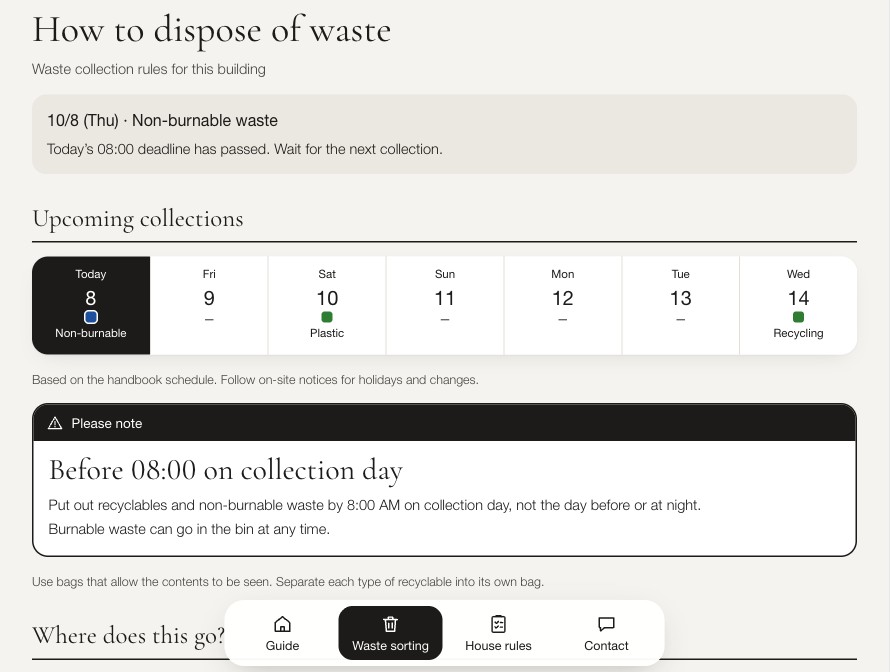
Waste sorting in the LOHUS Guest Guide. This is an example; your guide shows the rules for your own building.
If you are not sure about an item, type its name under "Where does this go?", for example "bottle" or "suitcase". The guide shows its category and collection day. Tap a category to see what belongs in it and how to put it out. If an item is not listed, send us a photo.
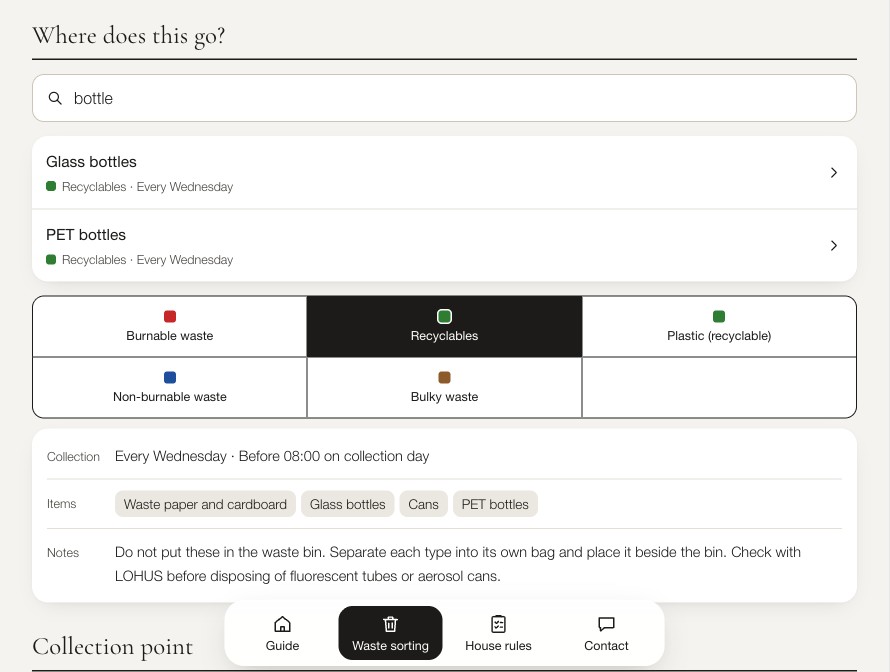
Searching for an item under "Where does this go?".
Cover photo: Arnepi Stocker / Unsplash

